

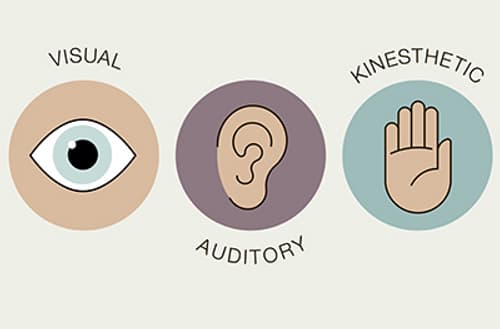
Learning styles refer to different approaches individuals naturally gravitate towards when acquiring information and developing skills. They're also sometimes called thinking styles or cognitive styles.
Imagine a toolbox — different people reach for different tools to tackle a problem, depending on their experience and comfort level. Similarly, we each have preferred tools for learning, even though we can eventually use all of them. Learning styles are not fixed: they can develop and change over time as we gain experience and are exposed to different learning methods.
When it comes to learning styles, a wide variety of theories exist. There are dozens of learning style models, but some of the most common ones categorize learners based on sensory preferences.
There are three main categories of sensory learning styles: visual, auditory, and kinesthetic. As you can see in the diagram below, these styles can overlap.

People with a visual learning style require visual stimuli to maximize their learning. They often have strong imagination and creativity, and can readily bring their ideas to life. When seeking understanding, they might ask you to "show them" rather than explain it verbally.
How to study if you're a visual learner?
Auditory learners excel at understanding and memorizing information they hear. Spoken instructions resonate more effectively than written ones. They often find lectures, discussions, and audiobooks to be powerful learning tools.
How to study if you're an auditory learner?
Tactile learners need hands-on experiences to understand and rememember new concepts. Physical activity helps them learn much more, faster. They often want to move around, take walks, or even do something else while listening to a lecture. These movements help them consolidate what they hear or read and recall information better.
How to study if you're a kinesthetic learner?
While this post explored the most common learning styles like visual, auditory, and tactile, remember that these are just frameworks. Most of us learn best through a combination of approaches. The most important thing is to become aware of your own learning preferences.
By understanding how you learn best, you can take charge of your education. You can tailor your learning methods to fit your skills and preferences and seek out resources and environments that resonate with your style.
Pro tip: Digital flashcards with voice features and diagrams are helpful for all three learning types. Try it for yourself!

Have fun & good luck with your studies!
The Voovo team
Instantly generate flashcards from anatomy diagrams, textbooks, and notes using AI, text recognition algorithms and Voovo's unique features.
 Voovo Secures $500K in Pre-Seed Round to Revolutionize Microlearning in Education through Spaced Repetition
 Company News
 Why am I tired?
 Use Cases & Study Tips
 Why flashcards are the best study tool
 Use Cases & Study Tips
 7 tips to study effectively at night!Use Cases & Study Tips
 AI vs. manual flashcard creation: Why you need both for 100% accuracyUse Cases & Study Tips
 3 reasons to study languagesUse Cases & Study Tips
 5 Proven Ways to Improve Your MemoryEducation
 5 tips for faster studyingUse Cases & Study Tips
 7 tips to cope with pre-exam stressUse Cases & Study Tips


