

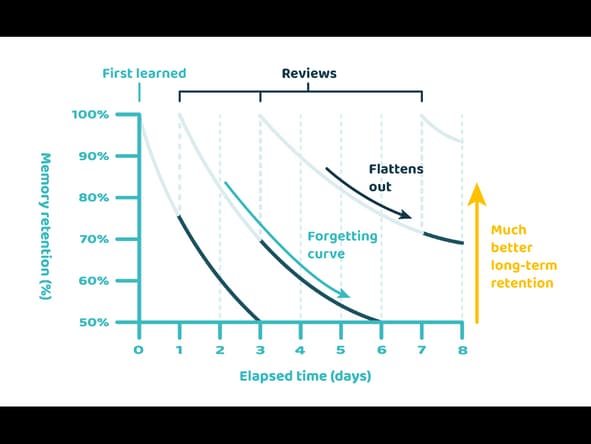
Spaced repetition is a widely recognized and evidence-based technique for improving memory retention and long-term recall of information. In a nutshell, space repetition involves dividing and spreading information over time, instead of attempting to learn everything in one go. The method is based on the forgetting curve, which shows a decline in recall ability over time unless information is reviewed. ⏳
The forgetting curve, a well-documented phenomenon in psychology, illustrates the natural decline in memory over time. The concept of the forgetting curve dates back to 1885, when German psychologist Hermann Ebbinghaus showed in his research how quickly information fades unless actively recalled.
Spaced repetition combats this by strategically reintroducing information at optimal intervals, strengthening memory pathways and preventing knowledge from slipping away. By spacing out the review of information, spaced repetition helps to overcome the decline in recall ability and leads to better memory retention and long-term recall. This is because the spacing of reviews allows for information to be processed and consolidated in memory, which helps to strengthen the neural connections responsible for recall. In this way, spaced repetition aligns with the principles of the forgetting curve, providing a highly effective and evidence-based approach to learning.
This curve helps to illustrate the need for spacing out the review of information over time, instead of attempting to learn everything in one go.

Cramming for exams might feel productive in the short term, but spaced repetition offers a scientifically proven path to long-term memory. Studies back up this approach:
These results highlight the effectiveness of spaced repetition in boosting memory retention compared to traditional study methods. 🧠
The short answer is yes. The vast amount of information medical students need to memorize can feel overwhelming. Luckily, there’s evidence that spaced repetition can significantly improve test scores. 💯
A study in the Journal of Medical Education demonstrated the effectiveness of spaced repetition for anatomy learning. Students who used this method achieved an average test score of 88%, a significant improvement compared to the 78% average score of those who didn't use spaced repetition.
The Voovo app is a useful tool for students to put spaced repetition into practice.
The app has a built-in spaced repetition system that adjusts the interval between reviews based on the user's interaction. Users can rate their knowledge of each flashcard, and the app determines the optimal time to trigger the information again for maximum retention.
Learn more about spaced repetition in Voovo from this video:
In conclusion, spaced repetition is a highly effective technique for improving memory retention and long-term recall of information. Medical students, in particular, can greatly benefit from using spaced repetition in their studies.
Voovo provides a useful tool to help students make the most of spaced repetition and achieve better results in their studies.
This blogpost was written by the enthusiastic team of students at Voovo. We believe in a world where the fact that students forget 95% of the information they learn in only 3 days is not overlooked. We developed the Voovo app to help students absorb loads of difficult information quickly by creating the fastest and easiest way to create and use flashcards. Furthermore, we are sharing our experiences and knowledge through well-researched articles and helpful study tips.
If you'd like to try spaced repetition using flashcards, download our app from the App store or Google Play.
Instantly generate flashcards from anatomy diagrams, textbooks, and notes using AI, text recognition algorithms and Voovo's unique features.
 Voovo Secures $500K in Pre-Seed Round to Revolutionize Microlearning in Education through Spaced Repetition
 Company News
 Why am I tired?
 Use Cases & Study Tips
 Why flashcards are the best study tool
 Use Cases & Study Tips
 7 tips to study effectively at night!Use Cases & Study Tips
 AI vs. manual flashcard creation: Why you need both for 100% accuracyUse Cases & Study Tips
 3 reasons to study languagesUse Cases & Study Tips
 5 Proven Ways to Improve Your MemoryEducation
 5 tips for faster studyingUse Cases & Study Tips
 7 tips to cope with pre-exam stressUse Cases & Study Tips


