

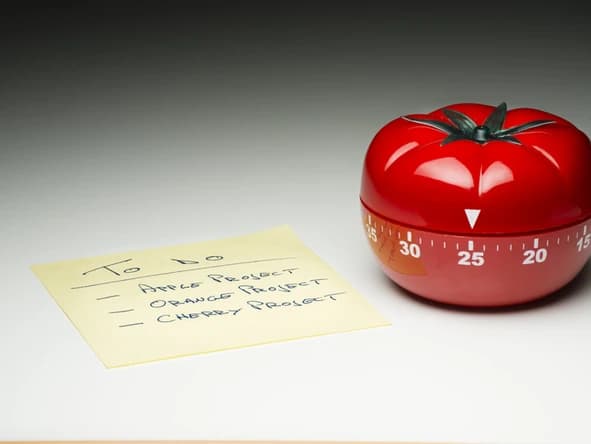
The Pomodoro technique is a popular time management and learning method that breaks work into focused intervals, typically 25 minutes long. These intervals are separated by short breaks to keep you focused and prevent burnout. After four sessions, you take a longer break to recharge.
In the 1980s, Francesco Cirillo struggled to focus on his college studies. He desperately sought ways to overcome procrastination and boost his motivation.
Deciding to break up his study sessions, he implemented a structured approach. He focused for 25-minute intervals, known as pomodori, followed by a refreshing 5-minute break. After four pomodori, he took a longer 15-30 minute break to allow his brain to rest and recharge before continuing.

Francesco Cirillo is Italian (I know, shocking). When he developed this technique, he used a tomato-shaped kitchen timer (pomodoro in Italian) to time his work sessions, which inspired the name of the method.
The Pomodoro technique combats boredom by breaking down studying into focused 25-minute intervals. These intervals are separated by short breaks, which refresh your focus and keep you motivated to tackle the material, without getting bored or overwhelmed.
It was shown that long stretches of work contribute to stress. Breaking work into smaller chunks can be also more fulfilling, since it increases the incentives for reward.
Multitasking and learning do not really go together. The Pomodoro technique reinforces this by promoting focused work within each 25-minute interval, eliminating the temptation to juggle multiple tasks.
Research also showed that the Pomodoro technique helps decision fatigue and prevents you from losing your reasoning ability and willpower.
A very interesting Israeli study highlights the importance of breaks in decision-making. Researchers examined judges and found that those who took breaks made more parole approvals, suggesting a clearer assessment of each case. Conversely, judges who worked without breaks were more likely to default to denials.
Parkinson’s law says that if you have a time-range to finish a task you are likely to stretch the task and use all the time you were given rather than finishing it as fast as possible. Since you are given time-slots, and they are only 25 minutes long, you simply beat the law!

Plan all the things you want to get done during the day. If some tasks seem bigger, feel free to break them down into smaller steps.
For each task, guess how many 25-minute work sessions (pomodori) you'll need. Be honest, but aim to be efficient!
Choose the most important task on your list and start your session by setting your timer to 25 minutes. Silence your phone, close any distracting tabs, and let everyone know you need focused time. Work hard for the entire 25 minutes, giving your full attention to the task.
When the timer rings, celebrate finishing a pomodoro! Get away from your work area for a short break. Avoid screens! Take a walk outside, get some fresh air, stretch, or grab a snack.
Return to your task and repeat steps 2 and 3. After four pomodoros (about 2 hours), take a longer break (15-30 minutes) to really recharge.
Tip: Remember, you should never switch tasks during one block!
Forest is not just a great app, but also contributes to planting real trees through donations to Trees For The Future. It helps you while working, studying or when you want to spend quality time with your friends. It is a great app for battling phone addiction, give it a try if you can!
Try the Pomodoro technique and let us know how it went in the comments!
If you want to study faster and more efficiently, download Voovo from theApp Store or Google Play.
Instantly generate flashcards from anatomy diagrams, textbooks, and notes using AI, text recognition algorithms and Voovo's unique features.
 Voovo Secures $500K in Pre-Seed Round to Revolutionize Microlearning in Education through Spaced Repetition
 Company News
 Why am I tired?
 Use Cases & Study Tips
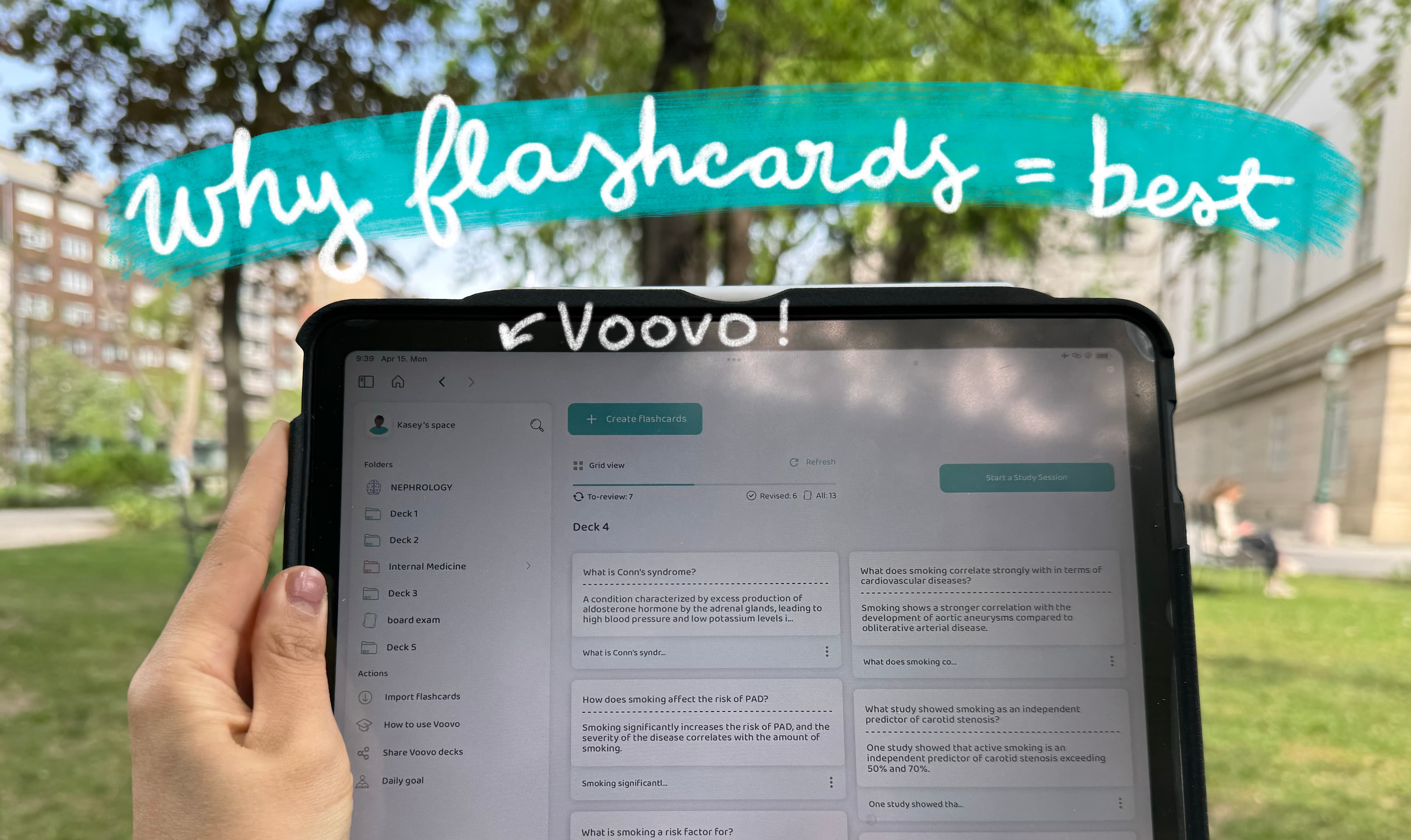 Why flashcards are the best study tool
 Use Cases & Study Tips
 7 tips to study effectively at night!Use Cases & Study Tips
 AI vs. manual flashcard creation: Why you need both for 100% accuracyUse Cases & Study Tips
 3 reasons to study languagesUse Cases & Study Tips
 5 Proven Ways to Improve Your MemoryEducation
 5 tips for faster studyingUse Cases & Study Tips
 7 tips to cope with pre-exam stressUse Cases & Study Tips


